USDA's latest quarterly grain stocks report shows US corn inventories rose 35% year-on-year to 2.10 billion bushels as of 1 September 2026, driving the December CBOT contract to a six-week low near 499 US cents per bushel. EU and Black Sea physical prices remain broadly stable amid ample global supply, with Brazil still shipping large export volumes and China projecting a strong 2026 harvest.
Soybean futures and products on the Chicago Board of Trade are undergoing modest profit-taking after a strong late-summer rally, with US September 1 inventories running about 3% below last year and Chinese demand continuing to underpin prices across the complex.
US corn and wheat futures recovered from multi-week lows on October 1, 2026, while soybeans fell across the complex. Key market drivers included a record-high US winter wheat acre abandonment rate, a sharp cut to Russia's wheat export forecast, surging US soybean export commitments led by China, and record combined biodiesel and renewable diesel production in July.
China's soybean import demand is expected to ease in the coming months as private crushers face negative crush margins and weak feed demand linked to shrinking hog herds. Soybeans were excluded from tariff relief announced after the Xi-Trump summit, keeping US cargoes uncompetitive with South American supplies. Domestic inventories at Chinese crushing plants have reached a 15-year high.
Japan's Dainichi Corporation is competing in the F3 Fish Farm Challenge 2025–2027, raising red seabream from juvenile stage to harvest on a diet free of marine-animal ingredients. The company is using soy protein concentrate and black soldier fly meal as principal alternatives, has invested in ingredient supplier Protenga, and is trialling AI-assisted feeding alongside hand feeding to optimise performance.
Agricultural commodity futures posted sharply divergent results in the week ending 25 September 2026, with November soybeans gaining 15½ cents to $13.19 per bushel and November feeder cattle surging nearly $14, while wheat contracts fell as much as 27¾ cents. China trade developments, harvest-season supply pressure, and commodity-specific fundamentals drove the split outcomes, according to a weekly market analysis published by Ag Bull on 26 September 2026.
China's 2026/27 soybean output is projected at roughly 20.95 million tons, marginally above last year, but the market is increasingly split between high-protein, food-grade beans commanding firm premiums and ordinary, lower-protein supplies facing harvest-period price pressure. Wet and cool weather in key northeastern provinces around late September is complicating fieldwork and drying logistics, adding quality and timing risk to an otherwise stable volume outlook.
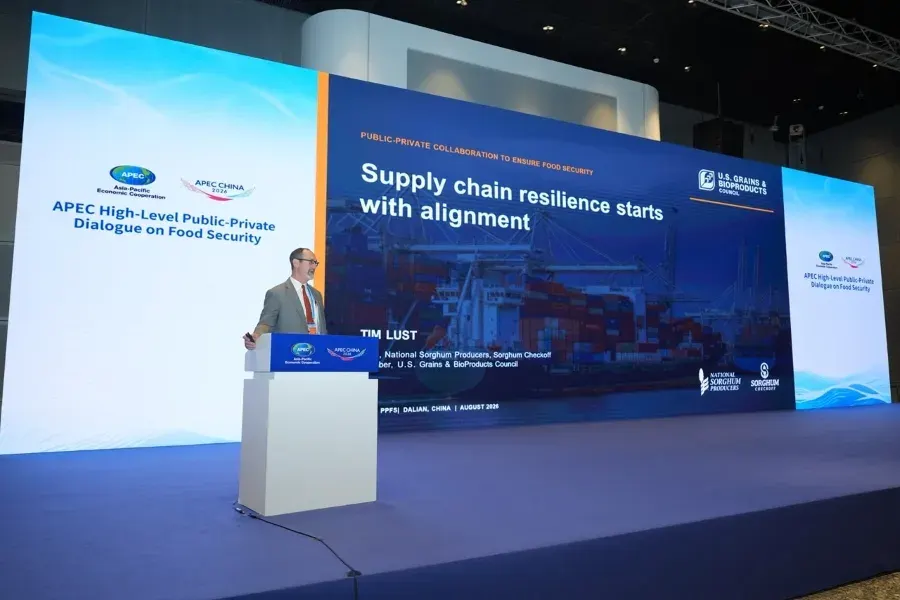
The U.S. Grains & BioProducts Council participated in the APEC High-Level Public-Private Dialogue on Food Security in Dalian, China, alongside nearly 150 representatives from across the Asia-Pacific region, with a focus on U.S. sorghum trade, bilateral agricultural relations, and regional supply chain resilience.
The UN Food and Agriculture Organization has distributed 100 tonnes of concentrated animal feed to 3,200 agropastoral households in Sudan's Red Sea State to protect livestock and sustain milk production amid drought-driven feed shortages, with the programme backed by US$2 million in emergency funding from the Government of China.
U.S. grain futures on September 25, 2026 finished near session highs after early selling pressure gave way to a recovery driven by a weaker dollar and trade-deal optimism. December corn edged up fractionally, November soybeans posted weekly gains on news of a U.S.-China trade subset agreement, while wheat futures ended the week lower amid a sustained price downtrend. Persistent Midwest rains are delaying harvest and tightening soybean supplies at processors.
Corn, soybean, and wheat futures all closed lower on 23 September 2026, pressured by weak ethanol output, lower EU and UK crop forecasts from Coceral, ongoing Black Sea military strikes, and shifting South American production outlooks, according to an ADM Investor Services market commentary.
Grain and oilseed futures closed mostly lower on 22 September 2026, according to ADM Investor Services analyst Mark Soderberg. Corn drifted back toward session lows while managed money extended a long position that ADMIS described as a potential record high. Soybeans finished mixed, soybean meal protein value reached a seven-month high, and wheat futures fell sharply amid ongoing Black Sea conflict and softening global supply signals.