USGBC Attends APEC Food Security Dialogue in Dalian, Engages Chinese Grain Market Stakeholders
The U.S. Grains & BioProducts Council participated in the APEC High-Level Public-Private Dialogue on Food Security in Dalian, China, alongside nearly 150 representatives from across the Asia-Pacific region, with a focus on U.S. sorghum trade, bilateral agricultural relations, and regional supply chain resilience.

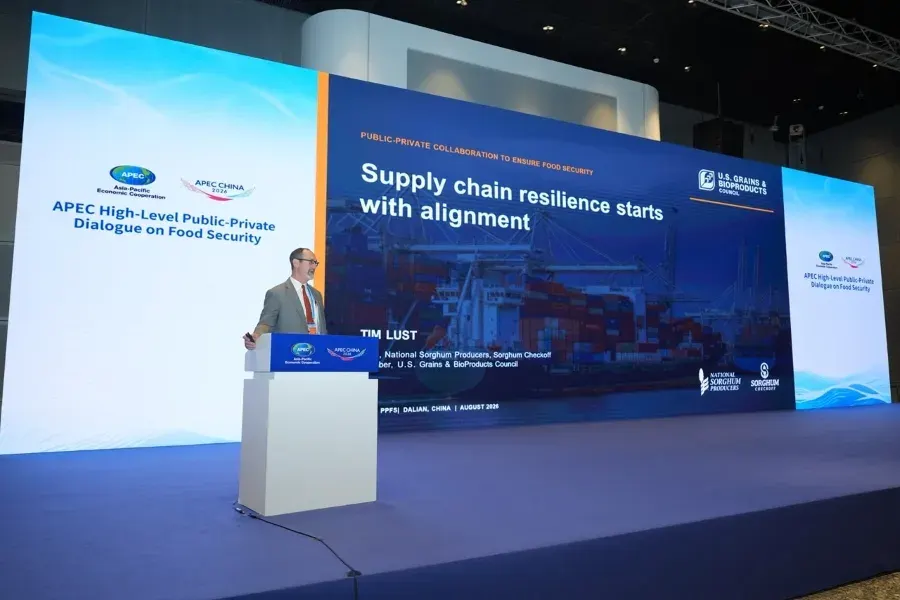
The U.S. Grains & BioProducts Council (USGBC) attended the Asia Pacific Economic Cooperation (APEC) High-Level Public-Private Dialogue on Food Security in Dalian, China, joining representatives from government agencies, industry associations, research institutions, and international organizations across the APEC region.
According to the USGBC, the event drew nearly 150 representatives from APEC member economies. A thematic forum was held under the title "High-Quality Development of the Grain Industry and New Opportunities for Asia-Pacific Regional Food Security Cooperation."
The USGBC delegation included USGBC Director in China Manuel Sanchez, USGBC Program Manager Ellie Yan, and National Sorghum Producers and United Sorghum Checkoff Program CEO Tim Lust. The delegation attended to emphasize the importance of global agricultural connectivity in food security, according to the USGBC.
Lust delivered a presentation stressing the role of public-private partnerships, with industry organizations serving as the link between growers, exporters, and end-user markets. He also highlighted trade as a stabilizing force that moves grain from surplus to deficit regions, reinforcing regional and global supply chain resilience.
"Food security depends on strong connections between the farmers who grow grain and the markets that need it," Lust said. He added that conversations at events such as this help U.S. sorghum producers understand customer needs, strengthen relationships, and identify opportunities for the crop.
While in Dalian, the team visited a Sam's Club store to observe consumer trends, quality requirements, and pricing for imported agricultural products, and toured a local corn field to speak directly with farmers about planting practices and technology applications, the USGBC reported.
The delegation also held separate meetings with officials from the U.S. Department of Agriculture (USDA) and its Foreign Agricultural Service (FAS) to exchange views on China's macroeconomy, agricultural trade policy, and market trends. Side meetings with core customers covered China's sorghum import activity, customer priorities, U.S. sorghum production, harvest progress, and inventory.
USGBC Director in China Manuel Sanchez said the visits provided exposure to China's current economic climate, grain import landscape, and trade for feedstuffs, as well as practical discussions on procurement planning. "These exchanges will help the U.S. industry better understand the Chinese market demand and how it is evolving, contributing to stable bilateral trade and laying the foundation for a long-term, mutually beneficial partnership," Sanchez said.
The USGBC also expressed appreciation to Chinese authorities for their support during the visit and said it looks forward to deepening practical industry cooperation through continued dialogue.
Prepared with AI assistance and reviewed by the editorial team.