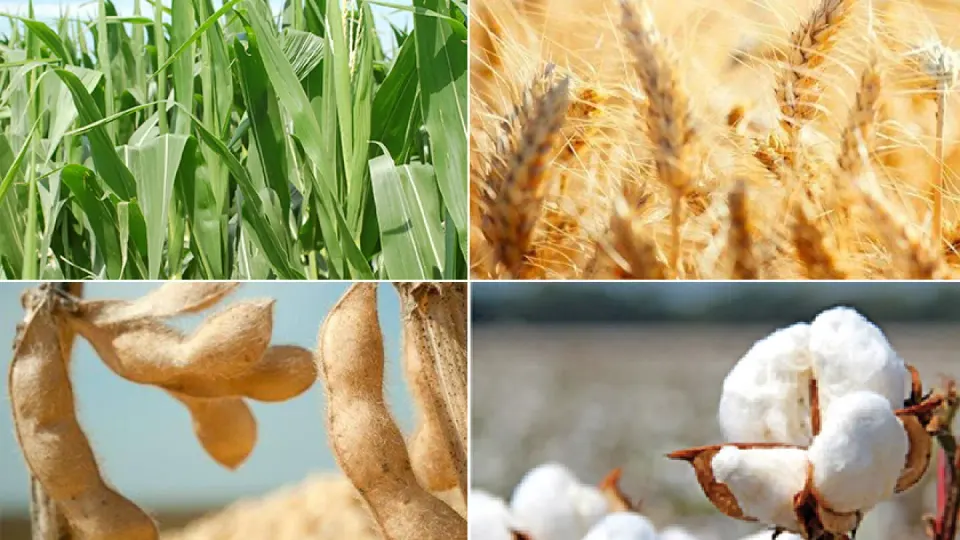
US soymeal, corn, soybeans and winter wheat all fell during the week ending October 3, 2026, as harvest pressure, larger corn inventories and improved soymeal availability outweighed supply concerns, according to CommodityScope's weekly physical markets report.
Heavy rainfall across the U.S. central and southern Plains is stalling winter wheat planting and interrupting corn and soybean harvest, while in Brazil, above-normal heat in key northern growing states is threatening early soybean planting. China's decision to cut tariffs on several U.S. agricultural commodities but leave soybeans under an additional 10% duty drove sharp losses in soybean futures on Monday.
USDA's latest quarterly grain stocks report shows US corn inventories rose 35% year-on-year to 2.10 billion bushels as of 1 September 2026, driving the December CBOT contract to a six-week low near 499 US cents per bushel. EU and Black Sea physical prices remain broadly stable amid ample global supply, with Brazil still shipping large export volumes and China projecting a strong 2026 harvest.
The USDA's September 30, 2026 quarterly stocks report showed corn inventories well above market expectations, a bearish signal for the feed grain, while wheat stocks came in below forecasts and soybean stocks were slightly supportive, according to an analysis by ADM Investor Services.
Soybean futures and products on the Chicago Board of Trade are undergoing modest profit-taking after a strong late-summer rally, with US September 1 inventories running about 3% below last year and Chinese demand continuing to underpin prices across the complex.
Wheat prices in the Rhine region are moving largely sideways heading into Q4 2026 and early 2027, with bread wheat quoted at 240 EUR/t for October–December and only a modest 4–5 EUR/t carry into Q1 2027. Corn and rapeseed are sending stronger price signals, with EU corn commanding a clear premium over feed wheat and rapeseed posting the steepest forward curve in the complex, drawing feed-sector attention away from wheat.
US corn and wheat futures recovered from multi-week lows on October 1, 2026, while soybeans fell across the complex. Key market drivers included a record-high US winter wheat acre abandonment rate, a sharp cut to Russia's wheat export forecast, surging US soybean export commitments led by China, and record combined biodiesel and renewable diesel production in July.
Deoxynivalenol (DON), commonly known as vomitoxin, is emerging as a significant problem in the 2026 corn harvest, prompting grain handlers including Dayton Cargill to test every load. The heat-stable mycotoxin concentrates in distillers dried grains and poses regulatory and financial risks for the animal feed industry.
Agricultural commodity futures posted sharply divergent results in the week ending 25 September 2026, with November soybeans gaining 15½ cents to $13.19 per bushel and November feeder cattle surging nearly $14, while wheat contracts fell as much as 27¾ cents. China trade developments, harvest-season supply pressure, and commodity-specific fundamentals drove the split outcomes, according to a weekly market analysis published by Ag Bull on 26 September 2026.
The U.S. Grains & BioProducts Council participated in the APEC High-Level Public-Private Dialogue on Food Security in Dalian, China, alongside nearly 150 representatives from across the Asia-Pacific region, with a focus on U.S. sorghum trade, bilateral agricultural relations, and regional supply chain resilience.
Ukrainian corn FOB and FCA prices at Odesa edged lower on 24 September 2026 as active Black Sea export flows kept seller competition intense, while French FOB corn firmed and German EXW values held broadly steady. CMB News expects mostly stable to mildly softer indications across Brazil, Germany and Ukraine over the next three days.
U.S. grain futures on September 25, 2026 finished near session highs after early selling pressure gave way to a recovery driven by a weaker dollar and trade-deal optimism. December corn edged up fractionally, November soybeans posted weekly gains on news of a U.S.-China trade subset agreement, while wheat futures ended the week lower amid a sustained price downtrend. Persistent Midwest rains are delaying harvest and tightening soybean supplies at processors.