South Korea's CJ CheilJedang Corp has signed an agreement with U.S. grain giant Archer Daniels Midland (ADM) to establish a joint venture targeting the feed-grade amino acid market in the Americas. CJ BioAmerica will hold a 63% stake and ADM 37%, with both companies contributing production facilities and business assets. The deal aims to combine CJ CheilJedang's fermentation technology with ADM's grain supply chain and logistics, pending regulatory approval.
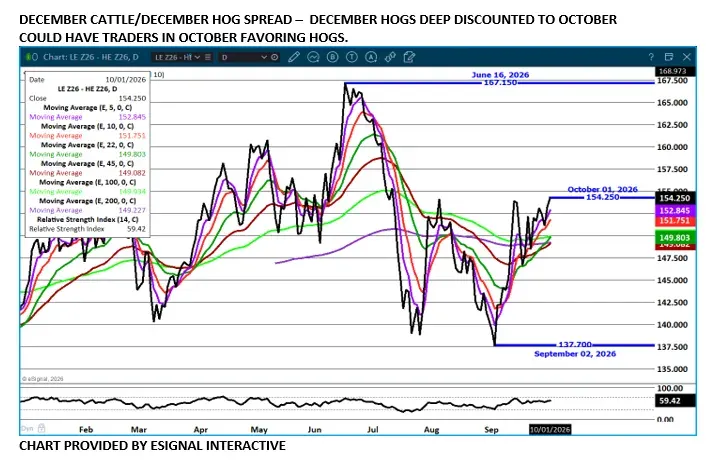
ADM Investor Services analyst Chris Lehner reported softer cash cattle prices in the week to 2 October 2026, citing rising grocery costs, high fuel prices, and widespread consumer financial stress as headwinds for beef demand. Lean hog futures hit new contract lows on the same day, with cheap chicken seen as competing against pork.
A peer-reviewed study in the journal Animals finds that soybean variety, growing location, crop year, and relative maturity can materially shift crude protein and amino acid profiles in southern Illinois soybeans, altering modeled soybean meal quality and livestock diet formulation outcomes for both ruminants and non-ruminants.
Heavy rainfall across the U.S. central and southern Plains is stalling winter wheat planting and interrupting corn and soybean harvest, while in Brazil, above-normal heat in key northern growing states is threatening early soybean planting. China's decision to cut tariffs on several U.S. agricultural commodities but leave soybeans under an additional 10% duty drove sharp losses in soybean futures on Monday.
U.S. grain futures rose in overnight trade on 30 September 2026 as markets positioned ahead of USDA's quarterly Grain Stocks report, a daily soybean export sale of 105,000 MT was reported, and the U.S. dollar index weakened. Analysts expect corn stocks to come in modestly below USDA's September WASDE figure, with attention focused on the Feed & Residual category.
ZentraVet, a brand of Aaharsetu Agri Solutions Private Limited, has grown its distribution network to more than 250 distributors across India, with Bihar emerging as a key market supported by more than 50 distributors, as the company works to improve farmer access to feed supplements and livestock nutrition products.
China has published a 1,619-tariff-line list of U.S. products eligible for consideration for lower tariffs, covering corn, wheat, cotton, beef, pork, dairy and ethanol, but notably omitting commercial (non-seed) soybeans and distillers dried grains with solubles (DDGS). Actual tariff reductions remain pending domestic legal processes in each country, and the widely cited "30-for-30" figures represent a 2024 trade valuation benchmark rather than a purchasing or savings commitment.
Agricultural commodity futures posted sharply divergent results in the week ending 25 September 2026, with November soybeans gaining 15½ cents to $13.19 per bushel and November feeder cattle surging nearly $14, while wheat contracts fell as much as 27¾ cents. China trade developments, harvest-season supply pressure, and commodity-specific fundamentals drove the split outcomes, according to a weekly market analysis published by Ag Bull on 26 September 2026.
The second day of the Compound Livestock Feed Manufacturers Association (CLFMA) of India's 67th National Symposium in Mumbai brought together policymakers, industry leaders, scientists and farmers to address feed security, artificial intelligence, veterinary capacity and government-industry collaboration in India's animal-agriculture sector.
Immigration enforcement operations in Kansas, Oklahoma and Texas have cut federally inspected cattle slaughter by more than 31,000 head versus the prior week through Thursday, September 25, 2026, with the Kansas Livestock Association, Oklahoma Cattlemen's Association and Texas Cattle Feeders Association warning of millions of dollars in lost revenue and delays to fed cattle deliveries. The disruption is affecting feedyards, processing plants, feed and grain businesses and transport operations across a region that accounts for roughly 22% of the nation's grain-fed beef supply.
Corn, soybean, and wheat futures faced sharp selling pressure on 25 September 2026, with all three grain markets breaking down technically amid disappointing outcomes from the Trump-Xi summit, a potential Iran-U.S. deal that pressured crude oil, and rising U.S. Treasury yields. USDA's Hogs & Pigs report added a bearish tone to cattle markets while offering a modestly supportive signal for lean hog futures.
The U.S. Grains & BioProducts Council escorted a 19-member South Korean feed and food corn buyer delegation on a multi-state tour of the U.S. corn export chain in September 2026, covering farms, ethanol facilities, grain handling sites and Pacific Northwest export terminals, as U.S. corn holds more than 80% of South Korea's import market so far this year.