South Korean Feed Corn Buyers Tour U.S. Export Infrastructure in Nebraska, Kansas and Washington
The U.S. Grains & BioProducts Council escorted a 19-member South Korean feed and food corn buyer delegation on a multi-state tour of the U.S. corn export chain in September 2026, covering farms, ethanol facilities, grain handling sites and Pacific Northwest export terminals, as U.S. corn holds more than 80% of South Korea's import market so far this year.

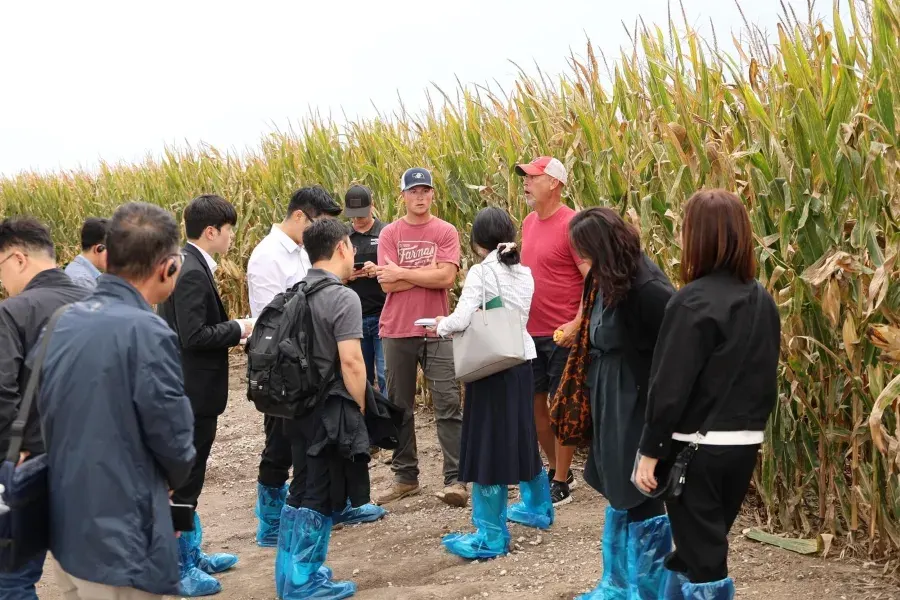
The U.S. Grains & BioProducts Council (USGBC) sponsored a 19-member team of South Korean feed and food corn buyers on a tour of the U.S. corn value chain earlier this month, visiting facilities across Nebraska, Kansas and Washington state, the organisation reported on 24 September 2026.
USGBC Director in South Korea Haksoo Kim escorted the delegation, whose purpose was to build closer business relationships with U.S. corn and corn co-product suppliers. Kim cited strong but price- and quality-sensitive Korean demand as the backdrop for the visit.
"U.S. corn accounted for more than two-thirds of South Korea's corn imports in 2025 and has captured more than 80% of the market so far this year," Kim said. He added that "Korean buyers remain highly sensitive not only to price competitiveness but also to quality, particularly broken corn and foreign material (BCFM) and moisture content."
The group began in Nebraska, where they met Nebraska Corn Board Director of Market Development Payton Schaneman for a welcome and an overview of the state's agricultural output. The delegation then toured Chief Ethanol and CPI Hastings Elevator to observe distiller's dried grains with solubles (DDGS) production and corn transportation through the value chain, followed by a visit to a local farm to view the current corn crop. The day concluded with a dinner meeting with USGBC Chairman Jay Reiners.
The following day included stops at Reinke Irrigation and Sullivans Farm to examine Nebraska's irrigation systems, technological advancements and precision agriculture. Nebraska Corn Vice President of Market Development & Grower Services Connie Fischer joined the team for a short course in Kansas, led by Darrell Holaday of Country Futures, covering changing corn market trends, grain hedging strategies and general market outlook. The group also visited Nunemaker Farm to assess local corn crop conditions and learn about corn use in livestock production.
A tour of DeLong's container transloading facility in Edgerton provided an examination of grain quality control, handling and transportation systems for containerised exports. The delegation then travelled to Washington state, visiting Blue Water Shipping and the EGT export terminal in Longview to discuss grain shipment trends at Pacific Northwest ports, quality control for export corn, and the status of corn exports.
Kim said the visit was intended to reinforce confidence in U.S. supply systems. "Exposing customers to the excellent quality and supply of the 2026/27 U.S. corn crop reinforced their trust in the U.S.' transparent and efficient grain export network and encouraged continued purchases year over year," he said.
Looking ahead, Kim stressed that ongoing quality assurance would be critical to maintaining market position. "Continued port-of-arrival quality monitoring and supply chain quality assurance remain essential to defending and growing U.S. corn's position in the Korean market," he said. The Council said it would continue supporting Korean buyers through trade teams and engagement with logistics stakeholders in South Korea.
Prepared with AI assistance and reviewed by the editorial team.