South Korea's CJ CheilJedang Corp has signed an agreement with U.S. grain giant Archer Daniels Midland (ADM) to establish a joint venture targeting the feed-grade amino acid market in the Americas. CJ BioAmerica will hold a 63% stake and ADM 37%, with both companies contributing production facilities and business assets. The deal aims to combine CJ CheilJedang's fermentation technology with ADM's grain supply chain and logistics, pending regulatory approval.
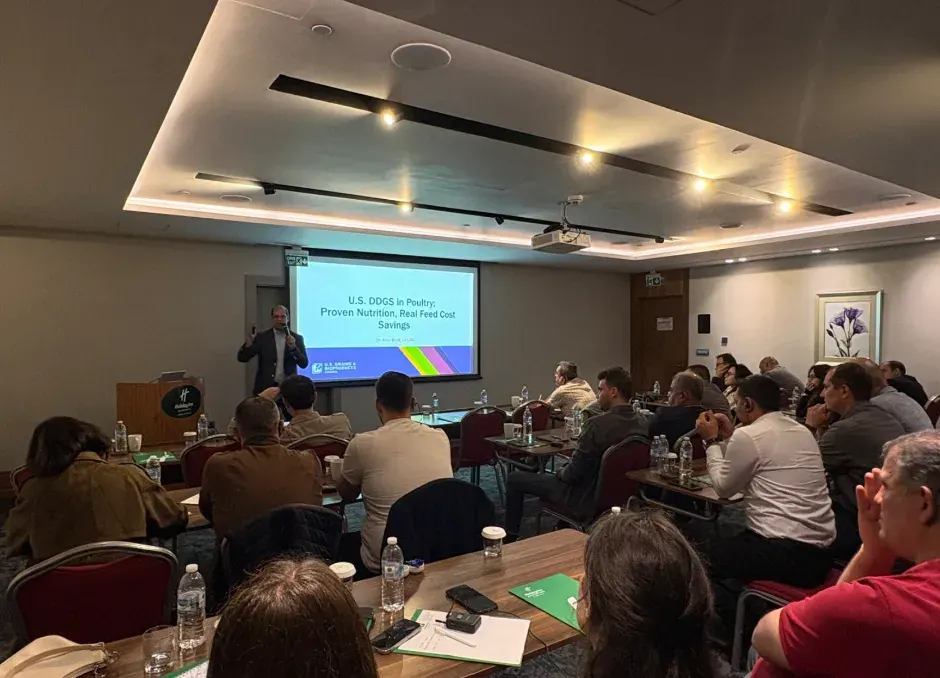
The U.S. Grains & BioProducts Council hosted three half-day seminars across Türkiye to address poultry and ruminant feed producer concerns over mycotoxins, antibiotic residues, and DDGS handling and storage, drawing 55 participants from 26 companies.
Sheng Long Aqua Technology, a subsidiary of China's Guangdong Haid Group, broke ground on August 10 on its first Malaysian aquafeed factory in Kamunting, Perak. The first phase carries a budget of approximately RM140 million, with operations targeted for 2028 and a nameplate capacity of 150,000 metric tonnes per year across two shrimp-feed and two fish-feed lines.
Senegalese poultry group Sedima is set to invest 20.47 billion CFA francs (US$35 million) in an integrated poultry and grain complex in Nkouo, Republic of Congo, targeting local corn, soybean and broiler production to reduce the country's dependence on imported feed and chicken.
UK FOB London pea prices have slipped modestly week-on-week as the 2026 domestic harvest under-delivered at roughly 69% of target, while stable and low Ukrainian FCA Odesa offers continue to cap upside for feed users.
Russia's Agriculture Ministry has formally proposed a 12-month moratorium on bankruptcy proceedings for grain producers after export bottlenecks caused a domestic price collapse, while EU and Black Sea physical wheat prices remained broadly flat. The Ministry of Economic Development has raised concerns about systemic financial risks, requesting evidence of exceptional circumstances before endorsing the measure.
The USDA's September 30, 2026 quarterly stocks report showed corn inventories well above market expectations, a bearish signal for the feed grain, while wheat stocks came in below forecasts and soybean stocks were slightly supportive, according to an analysis by ADM Investor Services.
The Agriculture and Horticulture Development Board's final assessment of the UK's 2026 cereal harvest shows winter wheat averaging 6.9 t/ha — about 11% below the five-year average — while spring barley and oats also fell well short of benchmarks. Oilseed rape was the sole standout crop, yielding roughly 19% above its five-year average. AHDB warns that some arable farmers are now facing a second or third successive difficult harvest.
Agricultural commodity futures posted sharply divergent results in the week ending 25 September 2026, with November soybeans gaining 15½ cents to $13.19 per bushel and November feeder cattle surging nearly $14, while wheat contracts fell as much as 27¾ cents. China trade developments, harvest-season supply pressure, and commodity-specific fundamentals drove the split outcomes, according to a weekly market analysis published by Ag Bull on 26 September 2026.
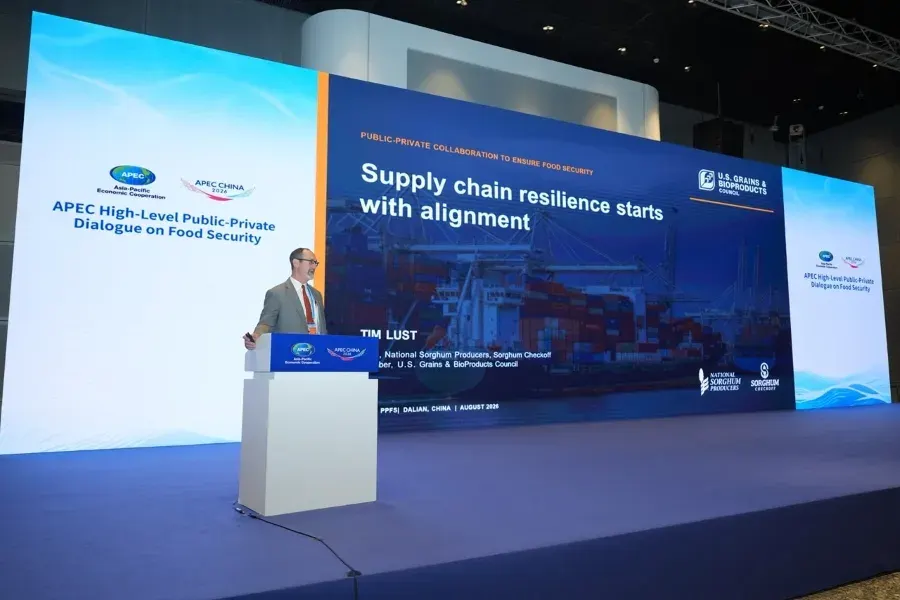
The U.S. Grains & BioProducts Council participated in the APEC High-Level Public-Private Dialogue on Food Security in Dalian, China, alongside nearly 150 representatives from across the Asia-Pacific region, with a focus on U.S. sorghum trade, bilateral agricultural relations, and regional supply chain resilience.
The Philippine Department of Agriculture is reviewing broader use of millet in animal feed rations to reduce the country's dependence on corn as a very strong El Niño, projected to persist into the first half of 2027, raises the risk of drought-related supply shocks. While corn remains the dominant feed grain, any large-scale millet adoption could gradually temper growth in Philippine corn import demand, a development international exporters are beginning to monitor.
Immigration enforcement operations in Kansas, Oklahoma and Texas have cut federally inspected cattle slaughter by more than 31,000 head versus the prior week through Thursday, September 25, 2026, with the Kansas Livestock Association, Oklahoma Cattlemen's Association and Texas Cattle Feeders Association warning of millions of dollars in lost revenue and delays to fed cattle deliveries. The disruption is affecting feedyards, processing plants, feed and grain businesses and transport operations across a region that accounts for roughly 22% of the nation's grain-fed beef supply.