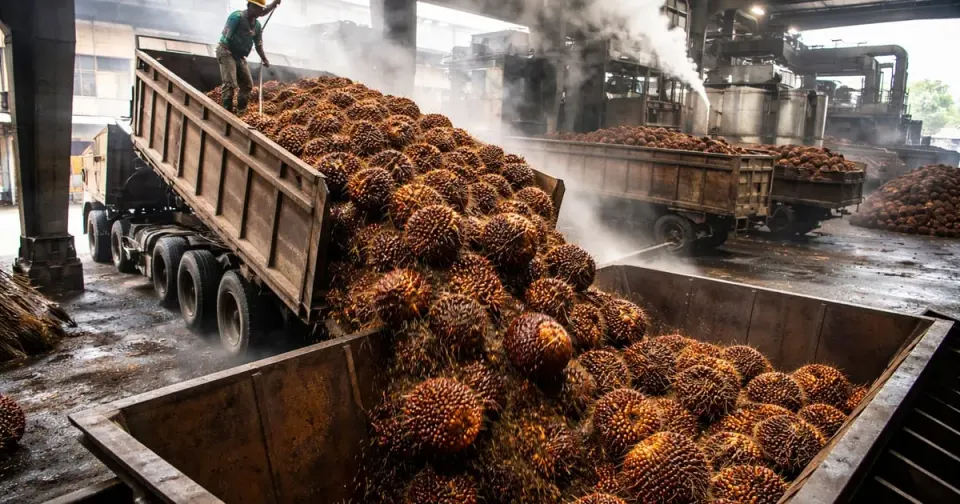
Malaysian palm oil futures fell around 2% on 25 September 2026, hitting their lowest levels since early August, as expectations of rising stocks above 3.1 million tonnes and weak Indian import demand weighed on prices. Analysts warn that El Niño-related yield losses could tighten the global balance in 2027, capping longer-term downside.
Indian organic starch corn FOB New Delhi has edged up to EUR 1.32/kg as a lagging kharif maize acreage, a weak monsoon backdrop and firm global corn sentiment keep sellers in a strong position. Black Sea and EU supply remain competitive but cannot fully offset the structural risk premium supporting Indian export-grade corn.
Ukrainian wheat prices remain depressed but stable as Black Sea export logistics keep volumes well below capacity, while German feed wheat trades sideways at elevated levels. The discount of Ukrainian origins to Western European benchmarks is expected to persist into early October 2026.
New Zealand dairy cooperative Fonterra has announced an incremental $1 billion investment over the next three years in the South Island to expand its protein manufacturing network and improve environmental performance, as the company reported a doubling of operating profit in fiscal year 2026.
China's 2026/27 soybean output is projected at roughly 20.95 million tons, marginally above last year, but the market is increasingly split between high-protein, food-grade beans commanding firm premiums and ordinary, lower-protein supplies facing harvest-period price pressure. Wet and cool weather in key northeastern provinces around late September is complicating fieldwork and drying logistics, adding quality and timing risk to an otherwise stable volume outlook.
Vylor, set to become independent from Corteva on 1 October 2026, and Belgian agricultural biotech startup Rainbow Crops have entered a collaboration to develop gene-edited corn traits using AI, multiplex genome editing, precision breeding, and automated phenotyping, targeting improved resilience to heat, drought, and flooding.
Ukrainian corn FOB and FCA prices at Odesa edged lower on 24 September 2026 as active Black Sea export flows kept seller competition intense, while French FOB corn firmed and German EXW values held broadly steady. CMB News expects mostly stable to mildly softer indications across Brazil, Germany and Ukraine over the next three days.
The Philippine Department of Agriculture is reviewing broader use of millet in animal feed rations to reduce the country's dependence on corn as a very strong El Niño, projected to persist into the first half of 2027, raises the risk of drought-related supply shocks. While corn remains the dominant feed grain, any large-scale millet adoption could gradually temper growth in Philippine corn import demand, a development international exporters are beginning to monitor.
U.S. grain futures on September 25, 2026 finished near session highs after early selling pressure gave way to a recovery driven by a weaker dollar and trade-deal optimism. December corn edged up fractionally, November soybeans posted weekly gains on news of a U.S.-China trade subset agreement, while wheat futures ended the week lower amid a sustained price downtrend. Persistent Midwest rains are delaying harvest and tightening soybean supplies at processors.
A strengthening El Niño event, combined with fertilizer shortages, geopolitical tensions, and elevated energy costs, could push global food and feed commodity prices up by 14–16%, according to procurement consultancy Beroe. Key feed ingredients including corn, vegetable oils, and sugar face varying levels of supply and price risk, with the full market impact potentially not materialising until 2028.
CBOT soybean futures eased modestly on 23 September 2026, with soybean oil leading declines and meal outperforming, as traders consolidated recent gains ahead of a key U.S.–China diplomatic summit. Ukrainian FOB prices slipped while basis held firm on below-average yields and Black Sea risk. China's August soybean imports remained historically large but showed a 12% year-on-year drop from the U.S., highlighting continued origin diversification. Early South American planting began under a wetter pattern, introducing mild bearish signals for new-crop supply.
Malaysian palm oil futures fell for a fourth consecutive session on 23 September 2026, with the December Bursa Malaysia contract dropping to MYR 4,768/tonne, as rising inventories, sluggish exports and soft rival markets reinforced a bearish near-term outlook.