
What are the latest formulation strategies for replacing fish oil with algal oil or terrestrial lipid blends in salmonid and marine fish diets without compromising omega-3 levels?
Recent trials show blending terrestrial fats with algal oils or using omega-3 byproduct oils can replace fish oil in marine and salmonid feeds while maintaining growth. A 75:25 beef tallow–algal oil blend preserved DHA in Asian seabass at control levels; FAEE oil fully replaced fish oil in European seabass without growth effects but reduced muscle DHA. A fish-free microalgae diet matched conventional performance in rainbow trout hatchery trials. Cost and supply scale remain key constraints for algal and novel ingredients.

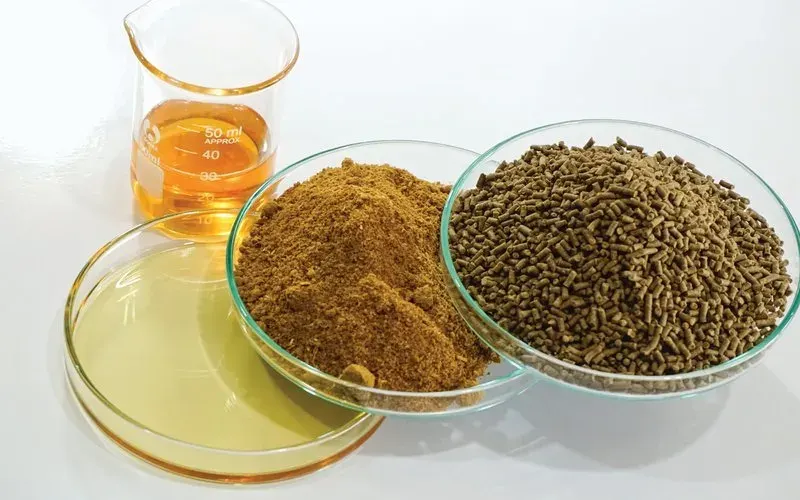
Fish oil replacement is a distinct engineering problem from fishmeal replacement
Replacing fish oil in aquafeed is fundamentally different from replacing fishmeal protein. Most plant oils supply short-chain omega-3 precursors that carnivorous marine fish convert to EPA and DHA poorly or not at all, making fish oil substitution a matter of sourcing the specific fatty acids — not simply swapping one lipid source for another. Algal oils cultivated to produce DHA and EPA directly are the most functionally equivalent alternative, but they remain considerably more expensive than commodity fish oil, meaning they are typically used strategically in premium feed lines rather than across all production volumes.
Blending beef tallow with algal oil: results in Asian seabass
A trial published in the Italian Journal of Animal Science tested complete fish oil replacement in Asian seabass (Lates calcarifer) using beef tallow (BT), Schizochytrium sp. algal oil (AO), and blends at a 43% crude protein and 13% crude fat level. Growth performance, feed efficiency, and key health indicators were unaffected across treatments. The most effective blend was BT75:AO25 — which maintained DHA levels comparable to the fish oil control, showed higher superoxide dismutase (SOD) activity, lower malondialdehyde (MDA), and stronger immune enzyme activity (ACP and ALP), indicating good antioxidant and immune status. Using algal oil alone (AO100) raised blood cholesterol and MDA, suggesting excess LC-PUFA at that level may increase metabolic stress. The researchers concluded BT75:AO25 offers a viable, cost-effective alternative for Asian seabass production.
FAEE oil: using an omega-3 processing byproduct in European seabass
Researchers from the University of Porto, CIIMAR, and the University of Florence, working with EPAX®, tested fatty acid ethyl ester (FAEE) oil — a byproduct discarded during omega-3 supplement production — as a complete fish oil replacement in juvenile European seabass (Dicentrarchus labrax). At up to 10.8% dietary inclusion, FAEE had no significant effect on growth performance, feed intake, feed efficiency, survival, or nutrient digestibility. However, muscle DHA declined sharply from 11.13% of total muscle fatty acids in the control group to 3.80% at the highest FAEE inclusion, and total muscle EPA + DHA fell from 16.11% to 8.57%. The authors suggested that dietary n-3 LC-PUFA requirements for juvenile European seabass may be lower than previously estimated, and that DHA supplementation may be needed at high FAEE inclusions to maintain the nutritional quality of the final product.
Microalgae-based fish-free diets in salmonids
A large-scale hatchery trial run at the San Joaquin State Trout Hatchery in California by California Sea Grant and the Kapuscinski-Sarker Lab at UC Santa Cruz tested a completely fish-free diet — replacing both fishmeal and fish oil with microalgae — in rainbow trout. Fish fed the microalgae diet matched the growth rates, final weights, and survivability of fish on a conventional commercial diet. The microalgae used (including Nannochloropsis sourced as a byproduct from omega-3 supplement production) are the original source of the long-chain omega-3 fatty acids that accumulate in fish. Matching commercial performance was regarded as a meaningful benchmark for industry adoption.
Why species and life stage change the strategy
Species differ substantially in their capacity to elongate short-chain omega-3 precursors into EPA and DHA. Salmon and trout have greater conversion capacity than species such as cod, meaning a precursor-rich blend that works in a salmonid may be insufficient in a strict marine carnivore. Asian seabass has limited C18 precursor synthesis capacity and relies heavily on dietary n-3 LC-PUFA, which is why the direct DHA contribution of the algal oil component in the BT75:AO25 blend mattered. For European seabass, fish selectively retained dietary EPA even as dietary levels declined, but muscle DHA still fell significantly. Life stage also matters: juvenile fish typically have higher n-3 LC-PUFA requirements than grow-out fish in many species.
Multiple alternative ingredients together, not one universal swap
A European Commission-commissioned study concluded that novel ingredients — insect meals, single-cell proteins, and microalgae — have nutritional and environmental potential but do not yet offer a universal, economically competitive replacement for conventional marine ingredients, constrained by cost, commercial-scale availability, and regulatory barriers. Nannochloropsis oceanica biomass comes close to fishmeal reference price, but microalgae still require productivity, harvesting, and processing improvements to compete widely. The evidence supports gradual diversification of feed formulation, combining raw materials according to price, availability, environmental footprint, and per-species performance, rather than a single complete swap.
What the evidence does not settle
There is no consensus on minimum n-3 LC-PUFA dietary requirements across all species and life stages — the FAEE seabass trial itself suggested existing recommendations for European seabass may be too conservative. Optimal algal oil inclusion rates differ by species. The long-term health and reproductive implications of reduced muscle DHA from high FAEE or high terrestrial fat diets are not fully characterised. Cost trajectories for algal and microbial oils remain uncertain. Each formulation decision should be validated against actual growth, feed conversion, and fillet fatty acid composition data for the target species, life stage, and production system.
Prepared with AI assistance by Endata and reviewed by the editorial team.
Sources
- 基于论文摘要,我拟定的专业标题为: 牛脂与裂殖壶菌藻油完全替代鱼油对尖吻鲈(Lates calcarifer)生理及代谢响应的影响 - 生物通
- Aquafeed.com | Omega-3 byproduct shows potential to replace fish oil in seabass feeds
- Can microalgae replace fish in fish feed? | California Sea Grant
- Beyond fish oil: What could close the omega-3 gap?
- New ingredients broaden aquafeed option but still face cost and scale constraints
- Sustitución de Harina y Aceite de Pescado: Lo que Demuestra la Evidencia