The Feed Desk is the editorial team behind The Feed Report, covering the global feed industry, animal nutrition, commodity markets, feed safety, aquaculture, and the forces shaping livestock and food production. The desk monitors industry developments, research, market data, company announcements, and regulatory changes to provide timely, focused reporting for feed and nutrition professionals.
Animal nutrition company Orffa has named Professor Nadia Everaert of KU Leuven to its Scientific Advisory Board, expanding the company's scientific depth in gut health and immunity research for poultry and pigs.
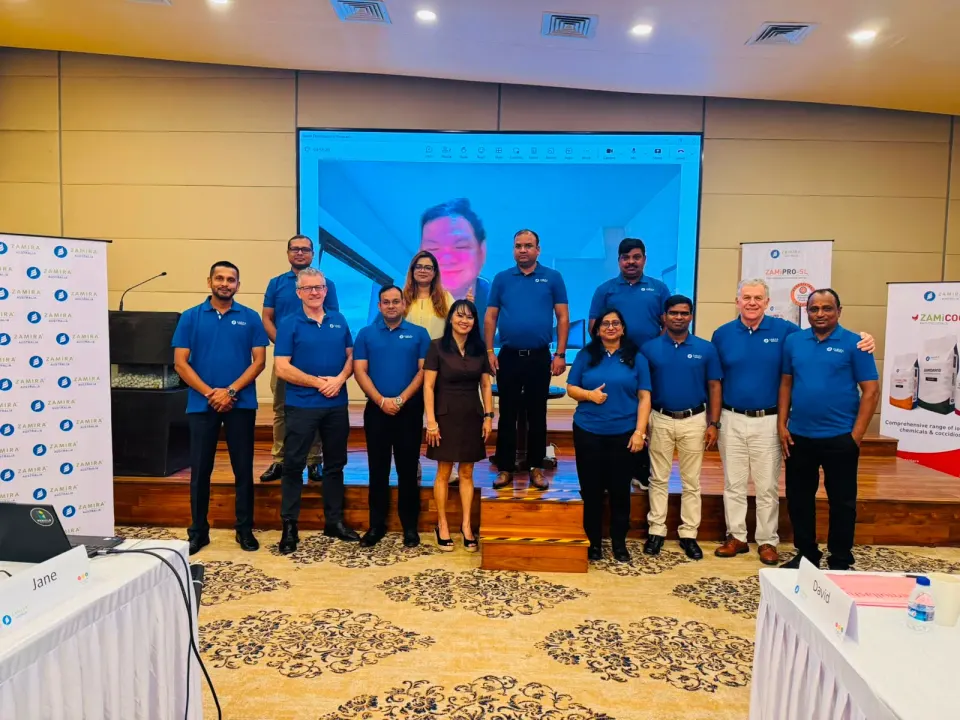
Animal nutrition company Zamira convened its South Asia team, global leadership, and channel partners for a three-day Annual Kick-Off Meeting in late July 2026, focusing on FY27 priorities, sales capability development, and technical training on its ZamiBoost product range.
Boehringer Ingelheim has inaugurated a new US Animal Health headquarters in Johns Creek, Georgia, consolidating employees and commercial activities to support innovation for companion animal and livestock markets, and complementing existing research, development, and manufacturing sites in Athens and Gainesville.
Philippine corn production is projected to fall 14.4% to 2.08 million tonnes following typhoon damage, with El Niño conditions forecast to intensify into late 2026. The supply squeeze is accelerating feed-industry interest in drought-tolerant millet as a partial corn substitute, while European and Black Sea export prices remain broadly stable.
A new study published in Emerging Infectious Diseases has identified previously unrecognised cross-border circulation of a multidrug-resistant Campylobacter coli sequence type across nine European countries between 2018 and 2025, challenging the long-held view that such infections are sporadic and unrelated. Poultry was identified as the primary animal source, and researchers are calling for coordinated genomic surveillance.
A series of typhoons in the Philippines has reduced July–September 2026 corn production by an estimated 14.4%, tightening regional feed grain availability and pushing up input cost risk for Southeast Asian feed manufacturers. CBOT December 2026 corn futures are trading around 529 USc/bu, while buyers consider alternative grains including millet.
Italy's soft wheat flour exports rose nearly 15% year on year in the first half of 2026, with the United States becoming the largest buyer after a 38% surge in imports, even as Black Sea wheat prices remain subdued and global grain benchmarks stay under pressure.
Star Meat Delivery Inc. of Lucama, NC, is recalling 167,639 pounds of raw pork, beef, and goat products that were produced without federal inspection and labelled with a counterfeit USDA mark of inspection, according to the USDA's Food Safety and Inspection Service (FSIS). The products were distributed through a Georgia distributor to retail and restaurant locations nationwide.
Tunisia's state grains agency has purchased around 125,000 tonnes of soft wheat at $311.72–314.23/tonne C&F for October–December shipment, setting a clear pricing floor for Mediterranean destinations and limiting near-term downside for Black Sea and EU export origins.
Kansas State University has officially opened the Western Star Global Grain and Food Center, a US$130 million, 178,000-square-foot facility that consolidates grain, milling, feed, pet food and food science programmes under one roof. The centre, the largest agricultural construction project in K-State's history, opened on 18 September 2026 and forms part of the university's broader US$216 million Agriculture Innovation Initiative.
The World Bank-supported Livestock Productivity and Resilience Support Project (L-PRESS) has distributed feed-processing equipment and improved pasture seeds to more than 40 livestock unions and several farmer clusters in Zamfara State, Nigeria, aiming to improve feed access and boost livestock productivity.
A multi-institution US study published in Aquaculture finds that adding 5% dried fish solubles to high-soybean meal diets significantly improved growth and selected fillet-quality traits in rainbow trout, with the effect driven primarily by increased voluntary feed intake rather than improved feed conversion.