El Niño Threatens Panama Canal Flows, Handing Brazil a Potential Grains Trade Advantage
A rapidly intensifying El Niño is tightening water levels at the Panama Canal and prompting precautionary draft restrictions, according to an analysis by agribusiness consultant Alê Delara published by CZ App on 17 September 2026. The weather event could raise US Gulf-to-Asia shipping costs, eroding US soybean and corn competitiveness and redirecting Asian demand toward Brazil — but the same climate risks that could lift Brazilian export premiums also threaten its domestic harvest and push up farm input costs.

A strengthening El Niño is generating a dual set of risks and opportunities for global grain and feed ingredient markets, potentially reshaping trade flows between the United States, Brazil and Asia, according to an analysis by agribusiness consultant Alê Delara published on 17 September 2026 by CZ App.
Panama Canal Draft Restrictions Take Effect
Water levels at the Panama Canal's Gatun and Alhajuela Lakes, which are used to operate the locks, have already declined due to reduced rainfall caused by El Niño. In August, the Panama Canal Authority announced new precautionary measures in response to lower-than-expected rainfall. According to the analysis, the maximum draft at the Neopanamax locks is set to be limited to 48 feet starting in September and 47.5 feet starting in October. The analysis notes these restrictions are precautionary and do not indicate an immediate risk of disruption.
The scale of potential disruption is illustrated by the 2023/24 drought. According to the analysis, citing Canal Authority data, the volume of grain transported through Panama fell from 35.8 million tonnes in fiscal year 2023 to 13.3 million tonnes in 2024. While volumes partially recovered to 24.7 million tonnes in 2025, that level remained approximately 31% below pre-drought levels. During the 2023/24 episode, grain shipments from the US Gulf to Asia were diverted via the Suez Canal, adding more than 5,000 nautical miles to the voyage and extending travel times by approximately two weeks.
Brazil's Routing Advantage
Key Brazilian shipping routes connecting Santos, Paranaguá, and the Northern Arc to China do not rely on the Panama Canal, the analysis notes, giving Brazil a structural cost advantage when US routing costs rise. A restriction at Panama would most directly affect US Gulf shipments, potentially shifting some Asian demand toward South America. For corn specifically, the analysis observes that freight costs account for a larger share of the final price, making the crop more sensitive to competition among origins; a more expensive North American route could favour suppliers in Brazil, Argentina, or the Black Sea region.
However, the analysis cautions that increased demand for South American cargoes can also keep vessels fully utilised and put upward pressure on Atlantic freight rates, qualifying the benefit for Brazilian exporters.
El Niño Intensity Rising Sharply
According to the analysis, citing NOAA's update released on 10 September 2026, the probability of El Niño becoming very strong starting in September in the Southern Hemisphere was raised from 93% to 97%. There is assessed to be a 75% chance that El Niño will be the most intense since 1950 during the October–December period of 2026.
Production Risks for Brazil's 2026/27 Crop
The same El Niño conditions that could boost Brazilian export premiums also pose direct risks to its upcoming harvest. In northern Brazil and the Matopiba region — comprising Maranhão, Tocantins, Piauí and Bahia — a "super El Niño" tends to cause more severe dry spells, according to the analysis. Matopiba accounts for approximately 14% of Brazil's soybean crop, while the Centre-West, where a moderate reduction in rainfall is forecast, accounts for nearly half of Brazil's production. Planting delays in the Centre-West may occur due to shifts in rainfall patterns.
The analysis identifies second-crop (Safrinha) corn as carrying the greatest production risk. Delays in soybean planting can push corn planting into May and June, when the crop risks facing dry spells typical of winter as well as frost, both of which reduce productivity. The analysis notes that a decent soybean harvest may therefore be accompanied by lower corn production.
In southern Brazil, as well as parts of Argentina, Paraguay and Uruguay, El Niño typically causes excessive rainfall, which can delay planting and harvesting and increase the risk of disease outbreaks such as Asian soybean rust. Intense storms and gale-force winds also risk causing corn stalks to lodge in states such as Rio Grande do Sul and Paraná.
US Crop Balance Offers Some Buffer
The analysis notes that the US 2026 soybean and corn crops will be well advanced by the time El Niño is expected to peak. In September, the USDA projected record production of 4.53 billion bushels (123.42 million tonnes) for the 2026/27 soybean season, with ending stocks of 310 million bushels (8.43 million tonnes), up from 4.262 billion bushels (115.99 million tonnes) produced in the previous season. The analysis concludes that available US supplies reduce the need for an immediate market reaction in Chicago to localised issues.
Rising Input Costs Compress Farm Margins
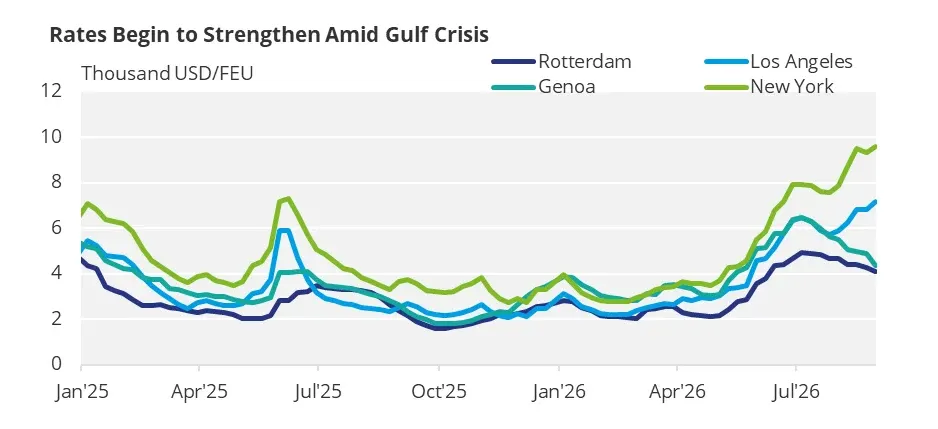
The analysis warns that higher commodity prices do not automatically translate into higher margins for producers. Brazil imports approximately 85% of the fertilisers it uses, and according to the USDA, the price of fertilizers delivered to the country has risen by about 33% since March of this year, impacting production costs. The analysis also cites the Strait of Hormuz crisis — which it says began in February following the conflict in Iran — as an additional factor raising energy and transport costs, with international agencies including UNCTAD recording rising costs and the IEA lowering its forecast for global oil demand in the second half of the year.
In Latin America, where hydroelectric power plays a significant role in many electrical systems, drought-driven reductions in reservoir levels typically lead to increased consumption of LNG, diesel and fuel oil, further pressuring farm input costs. The analysis concludes that a rise in soybean, corn, sugar or cotton prices does not guarantee higher margins if it is accompanied by lower productivity and an increase in costs.
Prepared with AI assistance and reviewed by the editorial team.