Loading…
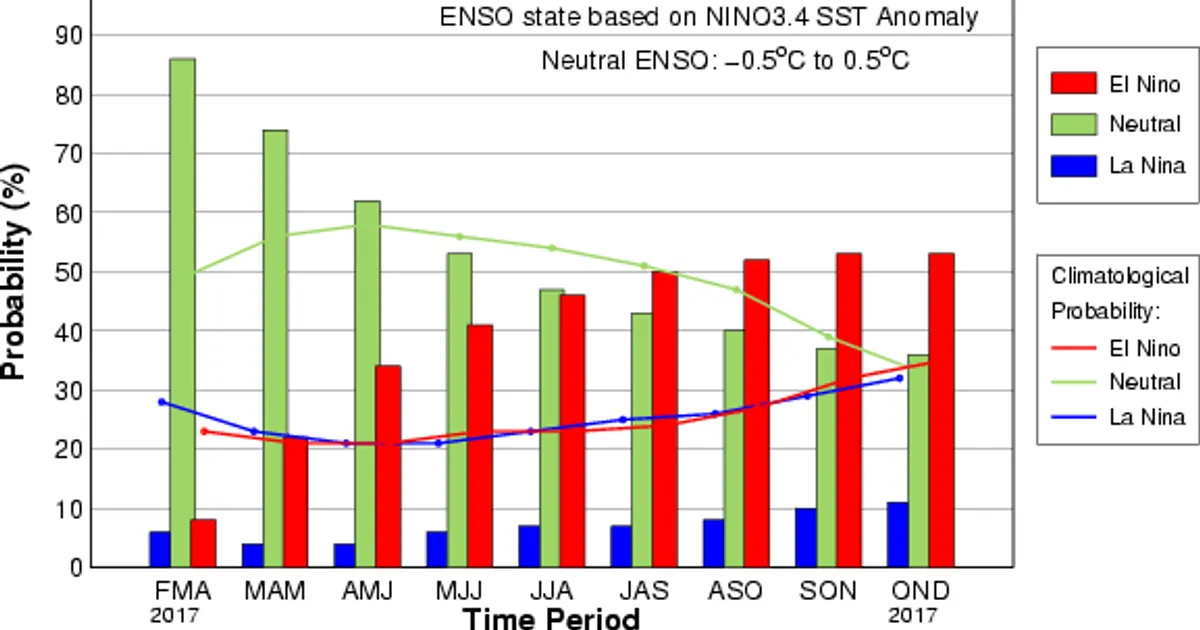
The International Research Institute for Climate and Society explains that NOAA's official forecast puts the chance of El Niño later in 2017 at about 50%. Model-only forecasts have recently shown a higher chance than forecasts that include human judgement.
The institute notes models are less accurate for the April-June period.
The uncertainty around El Niño timing means the weather-driven supply risk for feed grains remains unresolved, so markets may price in only a modest risk premium for now.
 medium.comInternational Research Institute for Climate and SocietyApr 18, 2017
After 2,467 past weather events, Corn moved a median +0.1% over 5 sessions (51% higher; middle half -1.5% to +1.7%), and +0.6% over 20.
After 1,964 past weather events, Soybeans moved a median +0.1% over 5 sessions (51% higher; middle half -1.7% to +1.8%), and +0.3% over 20.
After 1,773 past weather events, Wheat (SRW) moved a median +0.1% over 5 sessions (52% higher; middle half -1.5% to +2.1%), and +0.2% over 20.
After 361 past weather events, Palm Oil moved a median +0.0% over 5 sessions (51% higher; middle half -1.3% to +1.3%), and -0.2% over 20.
Moves of each commodity's benchmark from the last close before the event. Historical reads pool past events of the same kind; they describe what happened, not what will. Not investment advice.
