USSEC Holds Dual Aquaculture Feed Formulation Workshops in Bali to Advance U.S. Soy Use Across Asia
The U.S. Soybean Export Council convened two aquaculture feed formulation workshops in Bali in August 2026, bringing together commercial formulators and nutritionists from Bangladesh and eight Southeast Asian markets to build practical feed design skills around reliable ingredients including U.S. soy.

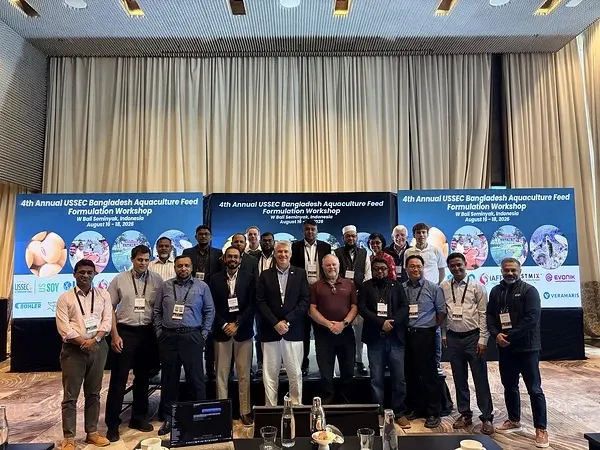
The U.S. Soybean Export Council (USSEC) held two back-to-back aquaculture feed formulation workshops in Bali, Indonesia in August 2026, convening commercial aquafeed formulators and nutritionists from Bangladesh and Southeast Asia to strengthen regional feed development capability.
The events — the 4th Annual Bangladesh Aquaculture Feed Formulation Workshop and the 12th Southeast Asia Aquaculture Feed Formulation Workshop — featured technical presentations, hands-on formulation training, and strategic discussions. Participants came from Bangladesh, Indonesia, Malaysia, Myanmar, the Philippines, Singapore, Thailand, and Vietnam.
According to USSEC, Asia accounts for a dominant share of global aquaculture production. The council cited its own market snapshot data, stating that the region is responsible for "over 90% of global aquaculture output." For the 2025/26 marketing year, USSEC said total U.S. soybean exports to Bangladesh, Indonesia, and Vietnam reached 4.65 million metric tons, while soybean meal exports to the three countries totalled 1 million metric tons to date, based on USDA Export Sales data for the week ending 27 August 2026.
This year's programme included around 25 technical presentations, with contributions from commercial companies alongside international specialists. Dr. Brett Glencross, Technical Director at IFFO – The Marine Ingredients Organisation, participated, sharing insights on ingredient performance and responsibly sourced raw materials in aquafeed development.
U.S. soybean farmers Brent Gatton of Kentucky and Thomas Frisch of Minnesota also attended, providing firsthand perspectives on sustainable U.S. soybean production practices.
Carlos Salinas, USSEC East Asia's Executive Director, said the combination of participants this year was distinctive: "What made Bali different was having formulators from eight markets, global nutritionists and U.S. soybean farmers working through real commercial formulation problems together. That is where U.S. Soy earns its place in a feed: not as a commodity, but as a consistent, verified ingredient that formulators can build a performance-focused diet around."
Lukas Manomaitis, USSEC East Asia's Aquaculture Lead, pointed to a broader shift under way across the region: "Across South and Southeast Asia, formulators are moving toward more advanced, performance‑focused feed development. Our goal is to help them formulate high‑quality, targeted feeds using responsible, reliable ingredients."
Sessions also introduced emerging digital tools intended to support more consistent and efficient feed development, according to USSEC.
The source of this report is a press release issued by USSEC, a body funded by the U.S. Soy Checkoff, USDA Foreign Agricultural Service matching funds, and industry, and whose stated mission includes promoting preference for U.S. soy in export markets.
Prepared with AI assistance and reviewed by the editorial team.