Tanzania's aquaculture sector posts fivefold production rise, eyes regional hub status
Tanzania's aquaculture output grew from 44,735 tonnes in 2020/21 to 234,525 tonnes in 2025/26, according to Ministry of Livestock and Fisheries data, as cage numbers, hatchery capacity and commercial feed use all expanded sharply. The country's director of aquaculture outlines priorities including feed manufacturing, cold-chain investment and sustainability governance ahead of the World Aquaculture Tanzania 2026 conference in Dar es Salaam.

Tanzania's total aquaculture production reached 234,525 tonnes in 2025/26, up from 44,735 tonnes in 2020/21, according to data published by the country's Ministry of Livestock and Fisheries (MLF). The figure includes 59,345 tonnes of aquatic animals — among them finfish, prawns, crabs and sea cucumber — and 175,180 tonnes of seaweed, with a combined reported value of TZS 446.8 billion (approximately USD 170 million).
The data were cited by Dr. Nazael Amos Madalla, Director of Aquaculture at the Ministry of Livestock and Fisheries, in a commentary published by Aquafeed.com on 22 September 2026. Madalla described Tanzania as entering "a defining moment in its aquaculture journey," positioning the sector as a strategic industry for food security, employment and economic growth rather than a subsistence activity.
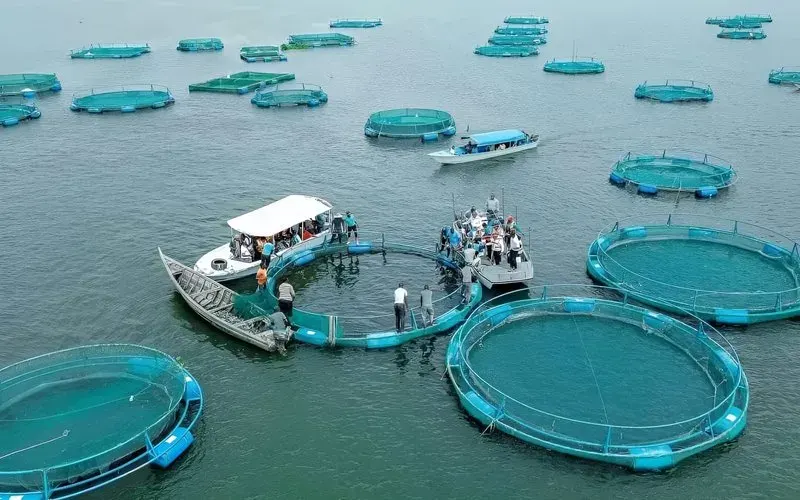
Supporting indicators tracked by the Ministry point to broad-based expansion across the supply chain. The number of fish cages increased from 473 to 3,343 between 2020/21 and 2025/26; hatcheries grew from 24 to 67; fingerling production rose from 24.2 million to 212.8 million; and commercial fish-feed utilisation climbed from approximately 1,182 tonnes to more than 23,600 tonnes over the same period.
Globally, the context is significant. According to FAO's State of World Fisheries and Aquaculture 2026, farmed aquatic animals exceeded 100 million tonnes for the first time in 2024, accounting for 53 percent of total aquatic animal production. Africa, however, retains a relatively small share of that output. Tanzania's per-capita fish consumption stands at 10.2 kg, below the global average of 21.3 kg cited by FAO, a gap that Madalla characterises as an opportunity to increase the availability of farmed fish.
Nile tilapia (Oreochromis niloticus) is described as the dominant freshwater farmed species. On the marine side, Tanzania is reported to contribute over 90 percent of Africa's seaweed production, with Eucheuma denticulatum (Spinosum) and Kappaphycus alvarezii (Cottonii) as the principal cultured species.
The government has also deployed targeted public finance. Through a partnership with the Tanzania Agricultural Development Bank (TADB), a total of 536 cages valued at TZS 12.574 billion, together with fingerlings and feed, were provided to 2,095 beneficiaries, according to the MLF's 2026 budget speech. Those supported farms had produced 593 tonnes of fish valued at TZS 4.617 billion at the time of reporting.
Spatial planning for cage expansion is under way. The identification of 99 suitable cage-farming sites covering about 220 km² in Lake Victoria, cited by Madalla from a FAO 2025 case study, is intended to reduce conflicts among resource users and protect aquatic ecosystems. Madalla called for the next phase to include site-specific carrying-capacity assessments, environmental monitoring and biosecurity measures, framing sustainability as "an investment enabler" rather than a constraint.
Key structural constraints identified in the commentary, drawing on Shoko et al. (2022), include limited availability of quality inputs, low commercial investment, inadequate cold-chain and value-addition infrastructure, and skills gaps — factors that Madalla also characterises as investment opportunities requiring aquafeed manufacturing capacity, cage fabrication, fish-health services, cold storage, refrigerated transport and digital farm-management systems.
Tanzania's aquaculture history dates to 1927, when farmed trout were introduced into cold-water streams in Kilimanjaro and Mbeya (Bailey, 1966), with tilapia pond farming following in the early 1950s. A dedicated Division of Aquaculture within the responsible ministry was established in 2008. The Fisheries (Aquaculture) Regulations, 2024 now form the principal regulatory foundation alongside broader legislation on water, land, environment, feeds and animal health.
The commentary was timed to promote World Aquaculture Tanzania 2026 (WA26T) and Aquaculture Africa 2026 (AFRAQ26), scheduled for 1–4 December 2026 at the Julius Nyerere International Convention Centre in Dar es Salaam. Aquaculture is recognised in Tanzania Development Vision 2050 as one of the transformative sectors contributing to the country's aspiration of a USD 1 trillion economy, according to Madalla's account of the URT (2025) document.
Prepared with AI assistance and reviewed by the editorial team.