Loading…
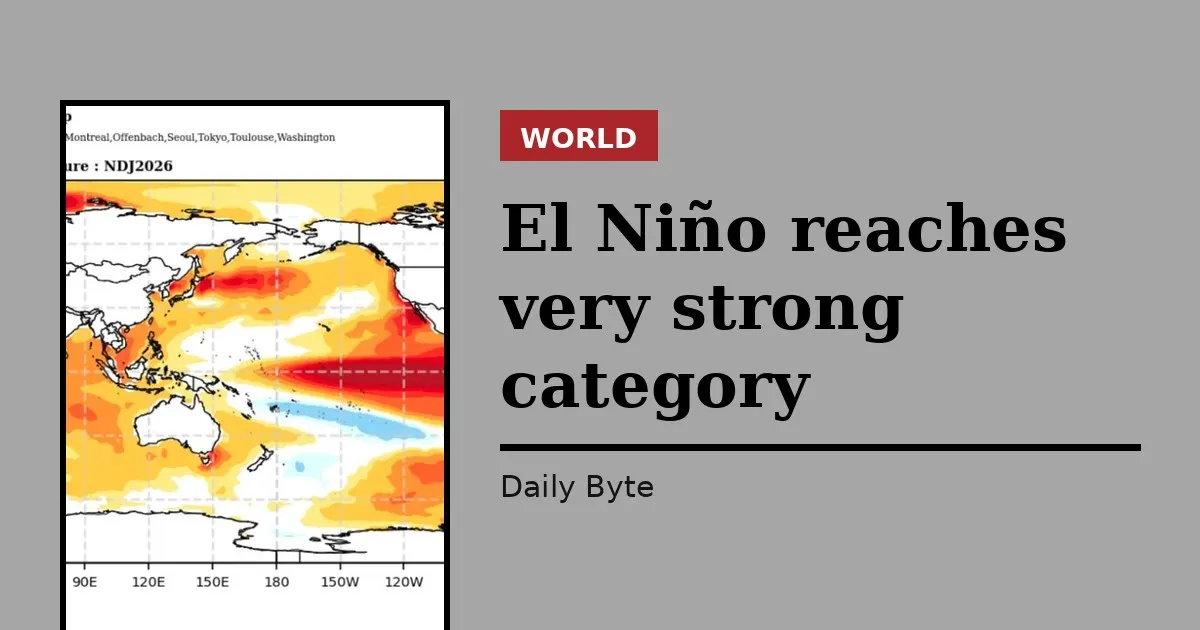
The 2026 El Niño has reached NOAA’s very strong classification, with the central equatorial Pacific sea-surface temperature anomaly at +2.0°C for August–October. The WMO forecast cited in the article projects the Niño 3.4 anomaly could reach +3.8°C in November–January, peaking in December.
A very strong El Niño raises the risk of weather-related disruption to crop production, which could tighten supplies and support prices if key growing regions are affected. The text gives no specific crop or regional production impact yet.
 dailybyte.pkThe Daily ByteNov 8, 2026
After 2,467 past weather events, Corn moved a median +0.1% over 5 sessions (51% higher; middle half -1.5% to +1.7%), and +0.6% over 20.
After 1,964 past weather events, Soybeans moved a median +0.1% over 5 sessions (51% higher; middle half -1.7% to +1.8%), and +0.3% over 20.
After 1,773 past weather events, Wheat (SRW) moved a median +0.1% over 5 sessions (52% higher; middle half -1.5% to +2.1%), and +0.2% over 20.
After 361 past weather events, Palm Oil moved a median +0.0% over 5 sessions (51% higher; middle half -1.3% to +1.3%), and -0.2% over 20.
Moves of each commodity's benchmark from the last close before the event. Historical reads pool past events of the same kind; they describe what happened, not what will. Not investment advice.
