Loading…
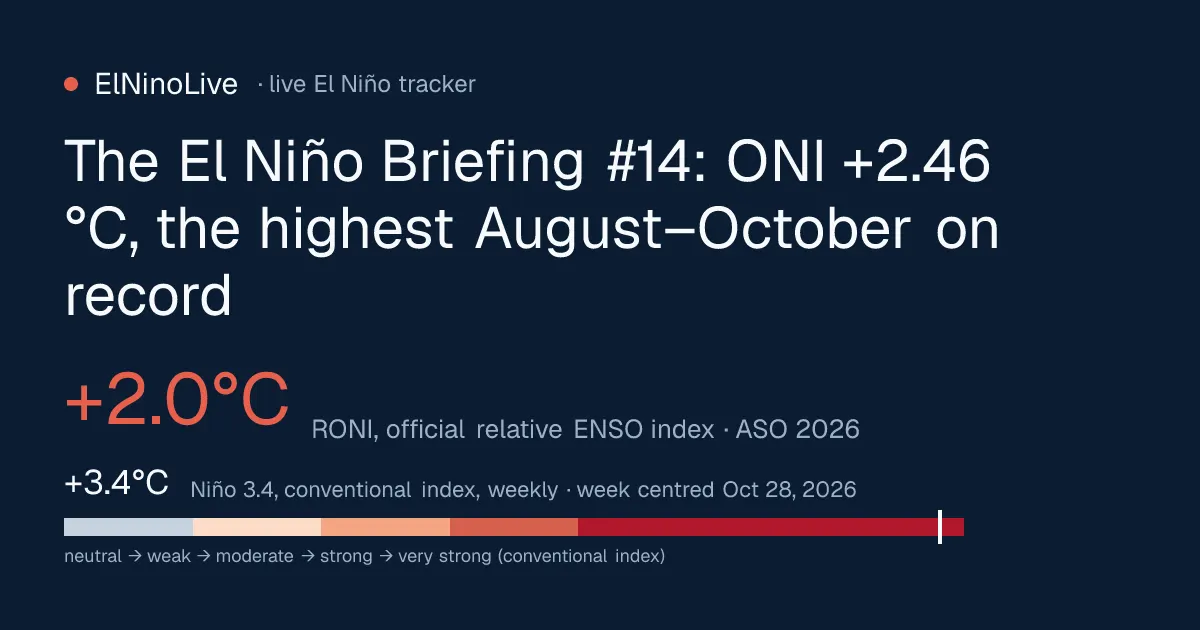
NOAA’s Oceanic Niño Index for August–October 2026 was reported at +2.46°C, the highest August–October reading in the record. Several other Pacific indicators also reached exceptionally high levels, including Niño 1+2 at +5.4°C, while Niño 3.4 held at +3.4°C for the week centered on October 28.
The exceptionally strong El Niño raises the risk of weather disruptions across crop-producing regions, which could tighten supplies and support prices for affected commodities. The article gives no crop-specific production estimates, so the market effect remains uncertain.
 elninolive.comIaroslav VladymyrNov 6, 2026
After 3,207 past report events, Corn moved a median +0.2% over 5 sessions (54% higher; middle half -1.3% to +1.7%), and +0.5% over 20.
After 2,389 past report events, Soybeans moved a median 0.0% over 5 sessions (50% higher; middle half -1.6% to +1.9%), and +0.1% over 20.
After 2,447 past report events, Wheat (SRW) moved a median +0.0% over 5 sessions (51% higher; middle half -1.5% to +1.8%), and +0.2% over 20.
After 349 past report events, Palm Oil moved a median +0.3% over 5 sessions (55% higher; middle half -1.0% to +2.0%), and +0.6% over 20.
Moves of each commodity's benchmark from the last close before the event. Historical reads pool past events of the same kind; they describe what happened, not what will. Not investment advice.
