Loading…
 FEEDSOFTAIFEEDSOFTAI
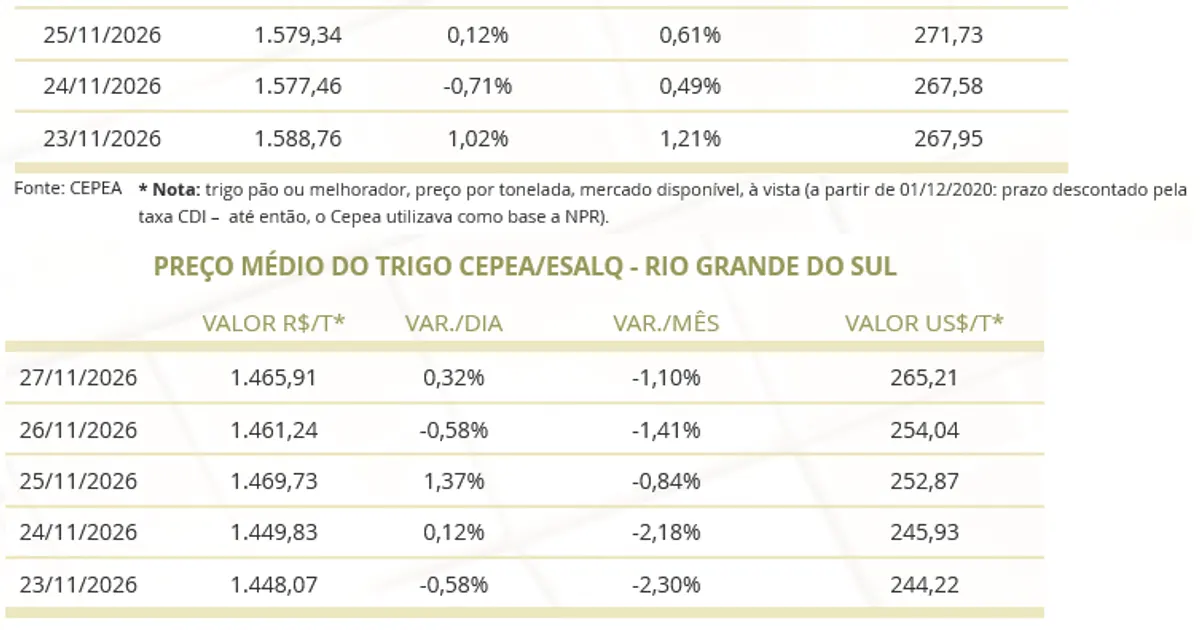
The Trigo Rosario reference for Argentine wheat closed at 189.5 US dollars per tonne on Friday, while Brazilian wheat in Rio Grande do Sul and Paraná traded at about 265 and 286 US dollars per tonne. Most of Brazil's harvest is feed-quality rather than milling wheat, and a sharp devaluation of the real has raised import costs for Brazilian buyers.
The price gap pushes Brazilian millers to buy Argentine wheat ahead of schedule, which supports Argentine export demand and draws supply away from the Brazilian market. The sharp real devaluation makes imports costlier, which partly offsets the cheaper origin.
 fulana.com.arE Escritor de Fulana News AgroNov 28, 2026
After 435 past bullish trade events, Wheat (SRW) moved a median +0.0% over 5 sessions (50% higher; middle half -1.2% to +2.1%), and +0.5% over 20.
Moves of each commodity's benchmark from the last close before the event. Historical reads pool past events of the same kind; they describe what happened, not what will. Not investment advice.