Lädt…
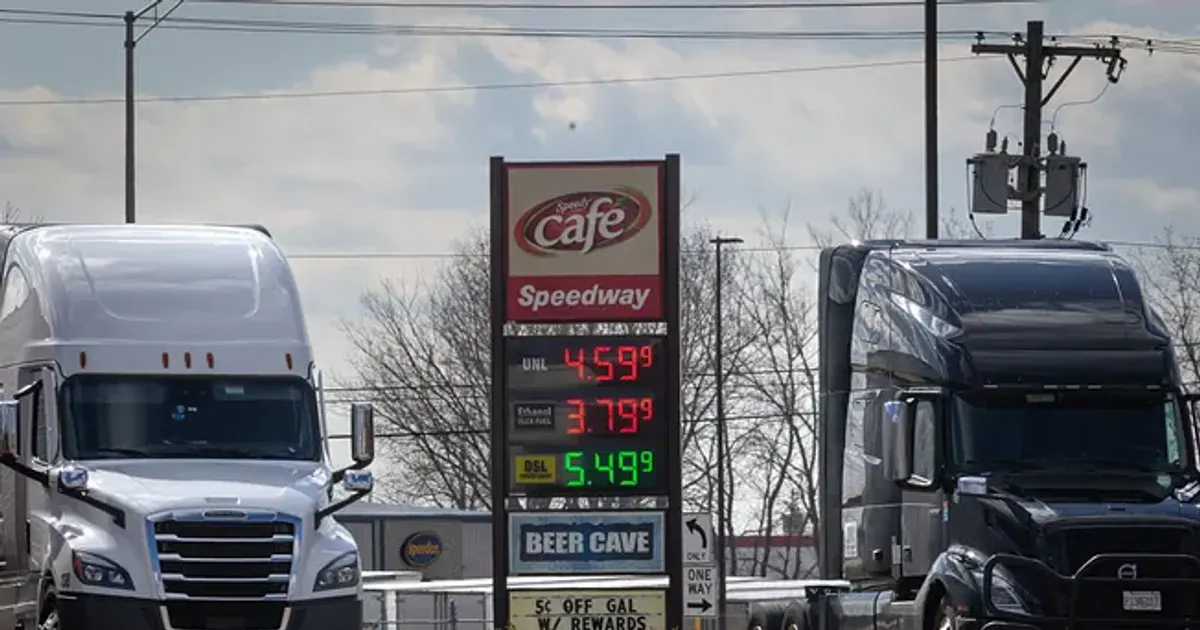
Brent crude fell below $95 at times after the US and Iran announced a two-week ceasefire, with Iran pledging safe passage through the Strait of Hormuz. Diesel prices had reached a national average of $5.64 per gallon before the ceasefire.
Analysts expect retail diesel relief to be slow and dependent on how the conflict is resolved.
Lower crude is a welcome cost relief for feed transport, but analysts expect retail diesel to fall slowly, keeping freight costs elevated. The outcome of the ceasefire will determine whether prices stay lower.
 truckingdive.comDavid Taube08.04.2026
Nach 250 vergangenen Ereignisse (bearisch, Geopolitik) bewegte sich Rohöl (Brent) im Median über 5 Handelstage um -3,1 % (36% höher; mittlere Hälfte -7,9 % bis +1,6 %) und über 20 Handelstage um -5,5 %.
Nach 255 vergangenen Ereignisse (bearisch, Geopolitik) bewegte sich Rohöl (WTI) im Median über 5 Handelstage um -2,4 % (31% höher; mittlere Hälfte -7,0 % bis +1,7 %) und über 20 Handelstage um -5,0 %.
Nach 51 vergangenen Ereignisse (bearisch, Geopolitik) bewegte sich ULSD / Diesel im Median über 5 Handelstage um -2,4 % (37% höher; mittlere Hälfte -8,2 % bis +3,9 %) und über 20 Handelstage um -2,3 %.
Veränderungen des Benchmarks jedes Rohstoffs seit dem letzten Schluss vor dem Ereignis. Historische Werte bündeln frühere Ereignisse derselben Art; sie beschreiben, was passiert ist, nicht was passieren wird. Keine Anlageberatung.
Brent fell below $95 on the ceasefire with Iran pledging safe passage through Hormuz, reducing the supply disruption premium in diesel.
Brent fell below $95 after the ceasefire and Iran's pledge of safe passage, lowering diesel feedstock and risk premia.
